Featured Story
Product
Tiny AutoScientist: Supersized Intelligence for Small Models


Most of the world doesn’t run on frontier models. It runs on constrained infrastructure, strict data environments, and latency requirements that frontier-scale systems cannot always meet. Those constraints demand a small model. The field’s knowledge of how to train one well was built for large models.
The result is a compromise most teams have quietly accepted: the model small enough to fit the constraints isn’t good enough, and the model good enough for the task is too big, too slow, or too expensive.
Today, we're introducing Tiny AutoScientist.
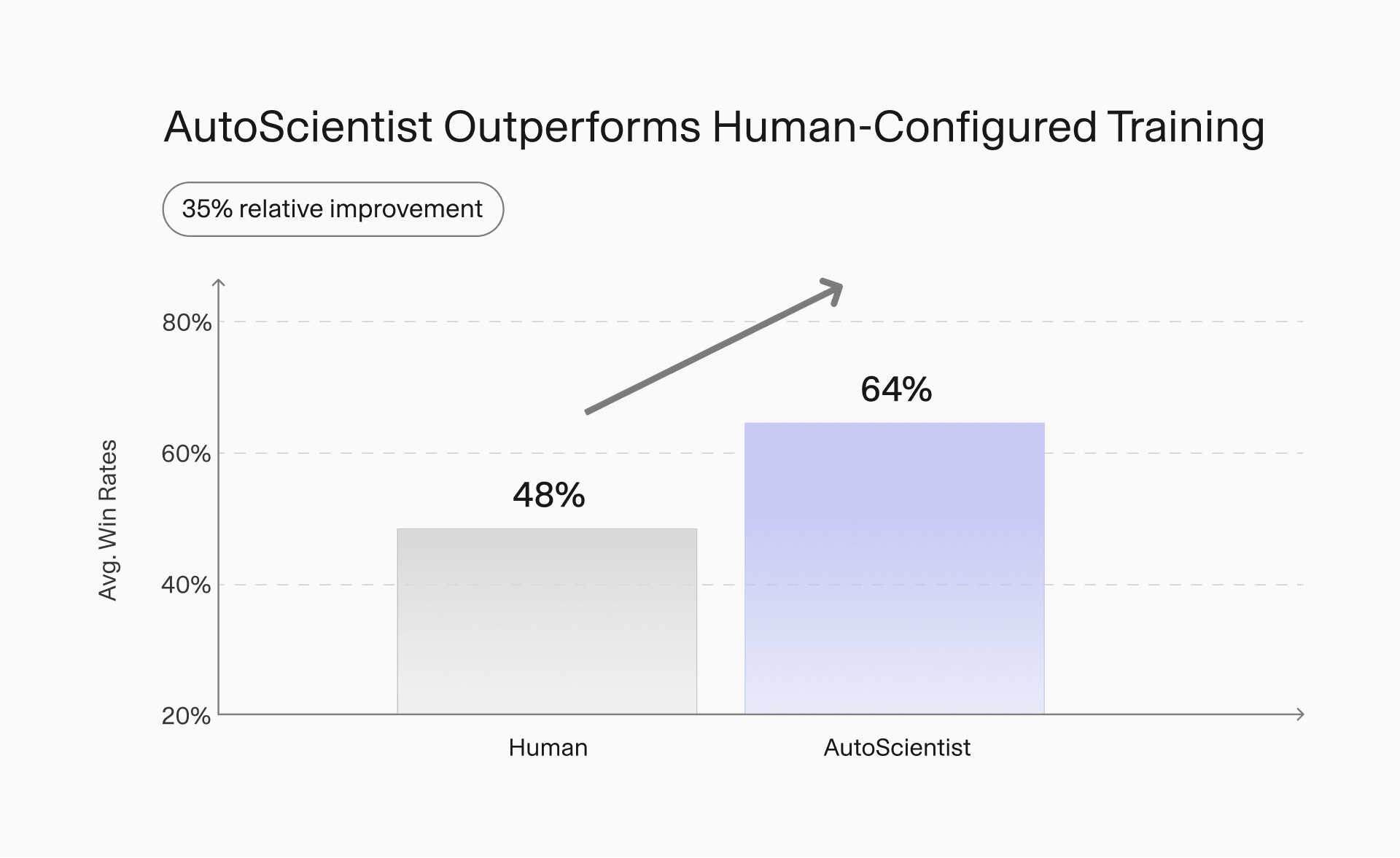
It’s the same AutoScientist system that already outperforms human configured training by 35% relative improvement. Those gains hold across dataset sizes from 5K to 100K samples and multiple model architectures. Consistently producing them, even when the baseline is set by an AI researcher. AutoScientist is a system that self-improves and automates the full research loop behind model training and alignment. It co-optimizes your data and model training recipes automatically, self-improving across both until quality converges on your objective.
Our research team has extended the same innovative approach to Tiny AutoScientist. It brings our automated research loop to models below 10B parameters, the 0.8B to 8B range most production systems actually deploy.
The research and development once reserved for frontier labs is now yours. Own and customize your model without compromise.
More Capability, Less Infrastructure
Small models are unforgiving. Less capacity means less slack, and the margin between a model that works and one that doesn't is narrow. Small models are more sensitive to learning rates, hyperparameter choices, and data quality where larger models aren’t. Small models are also prone to overfitting, which makes continuous learning difficult. Tiny AutoScientist automates the full R&D loop, guaranteeing frontier AI performance in days instead of months.
When the underlying task is narrow and well-defined, which most production workloads are, a small model trained correctly will outperform a large one trained carelessly. Scale has been the reflex because precise small model training has been out of reach.
Better Training, Better Models
The use cases that couldn’t justify a frontier model, such as edge deployment, on-device inference, latency-sensitive applications, regulated industries with strict data boundaries, were never impossible. They were waiting for the training to catch up. With Tiny AutoScientist, a small model trained correctly stops being a compromise and becomes the solution.
For years, progress in AI has largely been measured by making models bigger. Tiny AutoScientist reflects a different belief: capability is not determined by scale alone, and better training is just as powerful as a bigger model.
Date