Research
Featured Story
Self-Improving Intelligence for Long-Context Medical Reasoning



Wisedocs handles massive document volumes, scaling to process medical records exceeding 100,000 pages per case. Volume is also matched by complexity. In a medical record spanning a hundred visits, finding a relevant passage is critical. Tracking how a diagnosis changed, reconciling conflicting assessments or identifying every procedure requires connecting evidence scattered throughout the record.
AutoScientist automatically configures AI stacks to optimize for specific use cases. Unlike most AI customization, which requires significant expertise, AutoScientist infers in a self-improving loop the best modeling choices for each task. We showcase the impact of allowing AutoScientist to auto-configure an intelligence stack by benchmarking on held-out cases from the Medical Long Context Reasoning benchmark (MLCR). AutoScientist increased correctness on MLCR from 58.1% to 75.2%, outperforming GPT-6 Astra, Gemini 4 Argon and other frontier models. We also showed AutoScientist could supercharge the performance of a variety of open-weights models, with generalized gains when applied to DeepSeek and Qwen.
AutoScientist also dramatically lowers the cost profile of processing massive amounts of documents. AutoScientist applied to different open-weights models such as DeepSeek V4 Flash, Qwen 3.8 27B and GLM 5.3 results in 5x to 15.4x cheaper processing versus Claude Opus 5.5.
How MLCR Tests Reasoning Across Long Medical Records
MLCR (Medical Long Context Reasoning), built by Wisedocs, tests whether a model can reason across a long medical claim record. Each case contains 50 to 150 visit summaries, with complex questions across six difficulty tiers.
Each question is asked on the clean record and again with irrelevant medical and administrative forms interleaved at one and two filler pages per page of record, which pushes some prompts past 570,000 tokens.
Grading follows MLCR v1.1 and is strict. An answer counts as correct only if it passes a length gate, and a three-model jury judges it both factually accurate and complete. Completeness includes the reasoning and supporting evidence the question requires.
How a Lower-Cost Open Model Outperformed Frontier Models
Often, customization of models feels time-consuming and unpredictable. AutoScientist helps de-risk this, by automatically configuring model training and gradient-free learning techniques. For this set of experiments, we restrict AutoScientist optimization solely to optimizing and configuring everything except the model weights. This allows us to showcase how easily gains can come from applying AutoScientist to existing open weights models.
AutoScientist self-improvement was applied to three state-of-the-art open-weight models: DeepSeek V4 Flash, Qwen 3.8 27B and GLM 5.3. Across the 246-question evaluation set, DeepSeek V4 Flash’s correctness increased from 58.1% to 75.2%. That is a gain of 17.1 percentage points, or 29% more correct answers, with the model’s weights unchanged.
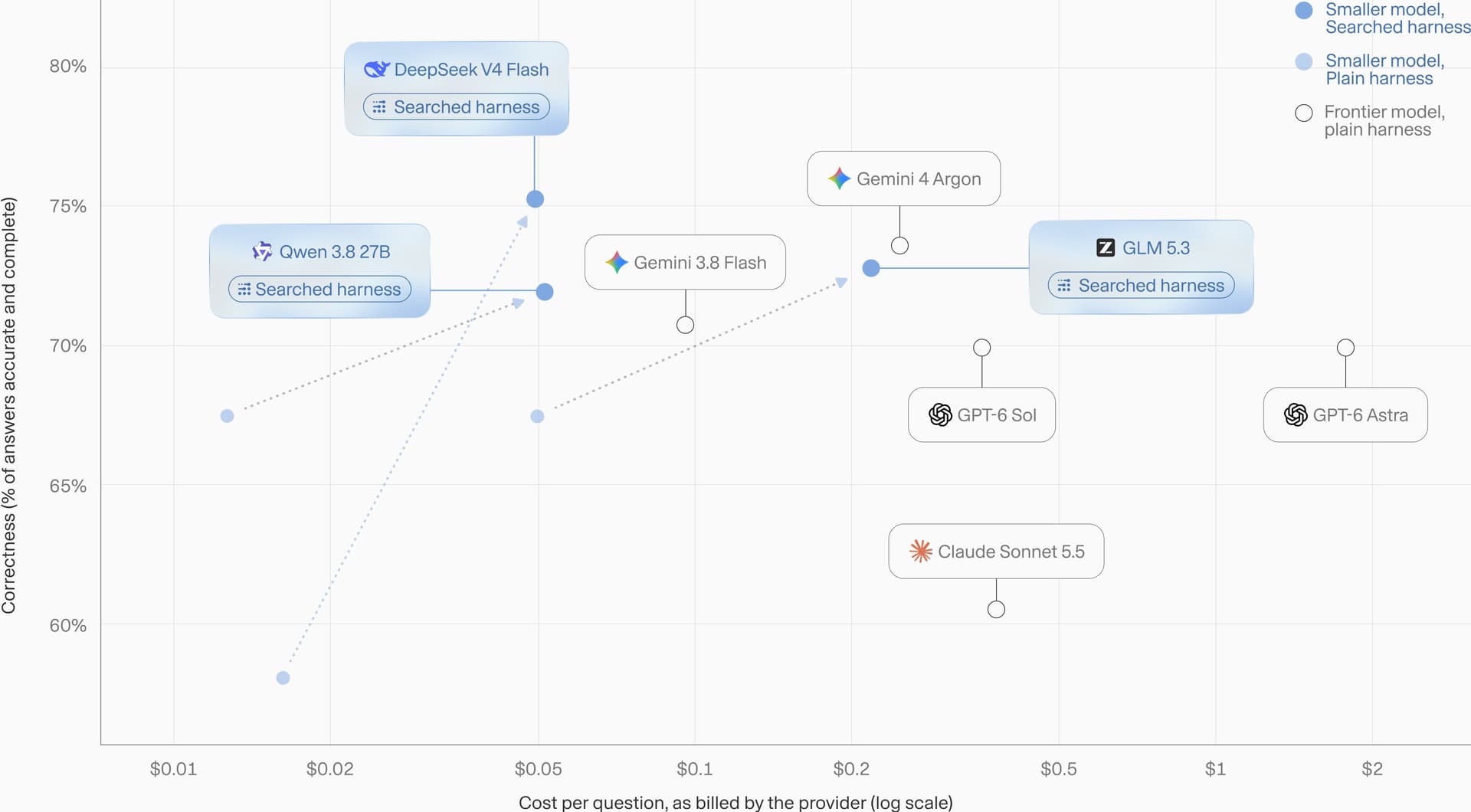
Figure 1. Automated Harness Search Improves Correctness Without Frontier Costs
AutoScientist also produced dramatic efficiency improvements. The optimized model stack brought DeepSeek V4 Flash within 4.9 percentage points of Claude Opus 5.5, the strongest model tested at 80.1%, with 15.4x cheaper processing.
AutoScientist applied to DeepSeek V4 Flash also outperformed several other frontier-model baselines that cost between 1.7 and 7.7 times as much per question.
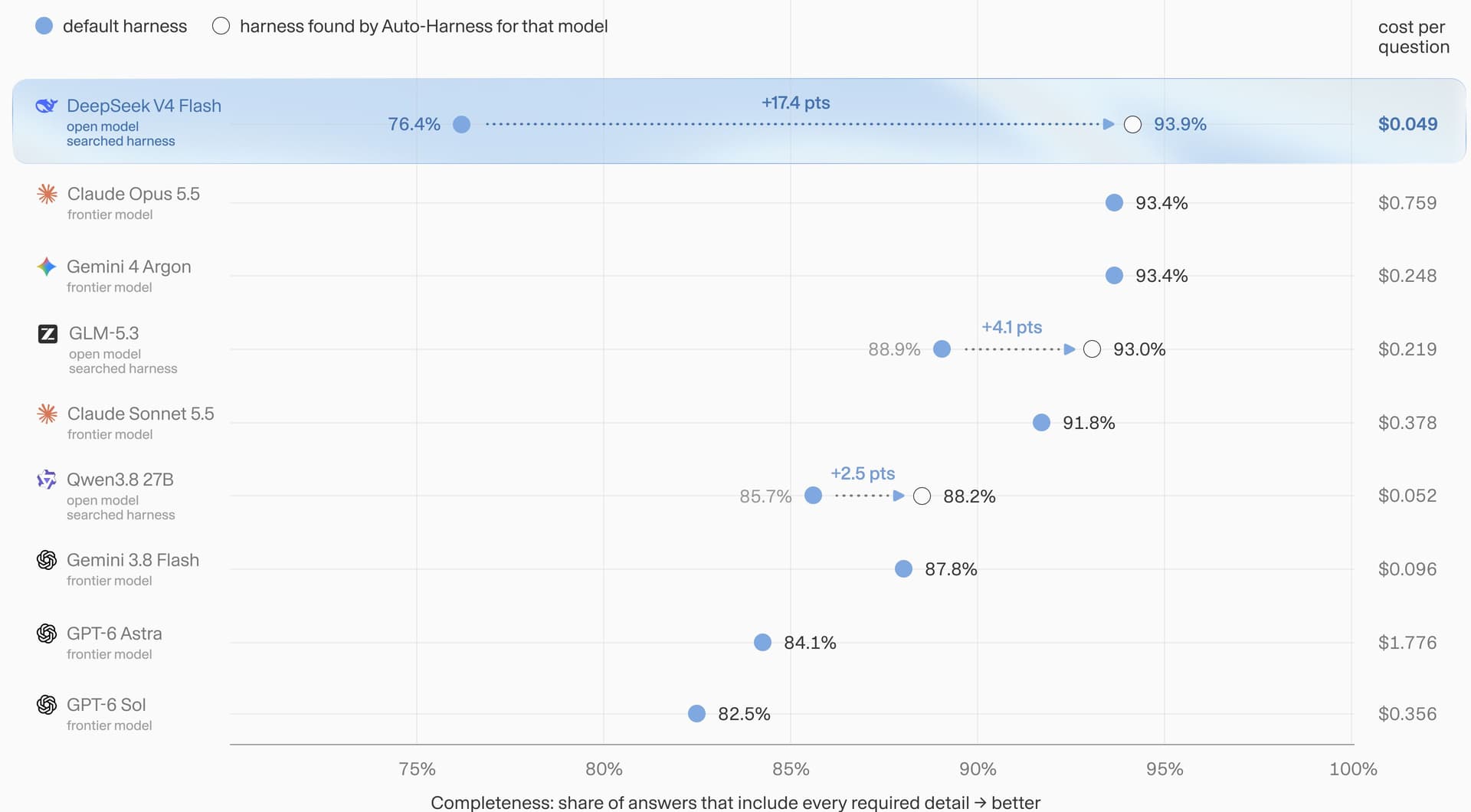
Figure 2. A Low-Cost Model Outperforms Frontier Models on Answer Completeness Without Retraining
The completeness pass rate rose from 76.4% to 93.9%, consistent with the evidence-coverage problem the harness targeted. Most of the overall gain came from Medium questions, which require combining facts spread across visits. Correct answers on those questions increased from 62 to 95 out of 123 evaluations, accounting for 33 of the 42 additional correct answers overall.
The searched harness was also more robust to the presence of irrelevant information. With a plain harness, adding filler forms dropped DeepSeek V4 Flash’s correct answers from 65.9% on clean records to as low as 52.4%. However, with the searched harness, it scored 75.6% on clean records and 74.4% even in the presence of a large amount of irrelevant pages.
Better Long-Document AI Without a Bigger Model
AutoScientist enables rapid self-improvement applied to any domain, applied on top of any open weights model to drive performance and efficiency gains. Contract review, financial due diligence and technical investigations place similar demands on a model. Evidence is spread across documents, individual facts need to be connected, and an otherwise sound answer can fail because a required detail is missing.
Date