Model Training
How to Improve LLM Accuracy Without Retraining Your Entire Model

When a model starts making mistakes in production, the instinct is to retrain it.
A full retrain is slow, expensive, and often solves the wrong problem. Most accuracy issues trace back to one of two places: the model lacks information it needs, or it behaves inconsistently with information it already has. Only the second one is really about the model itself, and even then, a full retrain is rarely the first or best lever to pull.
This article walks through four ways to raise LLM accuracy without retraining the entire model: prompt and context engineering, retrieval-augmented generation, lightweight fine-tuning, and continual data updates.
Diagnose the Problem Before You Reach for a Fix
Before choosing a technique, it helps to know which of two problems is causing bad output: context or behavior. If it’s context, that means the model doesn't have the information it needs, because that information wasn't in its training data, is out of date, or is proprietary. A behavior problem, on the other hand, means the model has the right information but still produces inconsistent formatting, tone, or reasoning.
There's a second reason this matters. Some accuracy gaps are one-time and can be patched. Others keep reopening as the underlying facts or edge cases change, and patching them individually stops working after a while. Continual learning is built to fix this (and we'll come back to it).
Prompt and Context Engineering
Prompt and context engineering adjusts what you ask the model to do and what information you give it alongside the question, without touching the model's weights.
How it works: Add clear instructions, examples of the input and expected output, or reference text the model can pull from directly in the prompt. A structured system prompt with two or three worked examples often turns a generic, wrong answer into a correct one.
Best for: Tasks with a clear right answer where the required knowledge already lives in the model or fits comfortably in the context window, such as classification, formatting, translation, or summarization.
Trade-offs: Prompt engineering doesn't scale well once a task needs a wide range of dynamic, per-query information; a static prompt can't hold every fact a business might need, and longer prompts cost more per call. When teams hit that wall, the model usually isn't wrong about the task, it just doesn't have the right facts in front of it.
The prompt itself is only part of the picture. A model's harness, the surrounding tools, context management, and delivery checks it's wired into, affects accuracy just as much as the wording of a single prompt. On a legal-agent benchmark, Adaption's research found that harness changes alone, with no change to the model's weights, moved an open model's task-pass rate from 67 percent to 85 percent.
Retrieval-Augmented Generation (RAG)
Retrieval-Augmented Generation, or RAG, retrieves relevant information from an external source, a document store, database, or search index, and inserts it into the prompt before the model generates an answer.
How it works: A query is converted into an embedding, matched against a vector database of pre-indexed content, and the closest matches are pulled into the prompt as context. The model then answers using that retrieved material instead of relying only on what it learned during training.
Best for: Questions that depend on current, proprietary, or fast-changing information, such as product catalogs, internal documentation, recent updates, or account-specific data, that a static prompt or the model's training data can't cover.
Trade-offs: RAG introduces a new failure mode: retrieval quality. If the search returns the wrong documents, or too many irrelevant ones, the model can't answer correctly no matter how well it reasons, and excess noise in the context can produce hallucinations rather than prevent them. Tuning retrieval, ranking, and chunk size becomes its own ongoing project.
RAG also depends on someone having written the right information down somewhere. Adaption's research on agent memory found a related pattern: the bottleneck usually isn't retrieval at all, it's what gets extracted into memory in the first place. Improving how memory is written, before any retrieval happens, raised accuracy on long, multi-session conversations from 39 percent to 61 percent against a comparable open-source memory system; Better Agent Memory Starts Before Retrieval covers the full results.
Lightweight Fine-Tuning: Adapters and Targeted Updates
Lightweight fine-tuning updates a small, targeted subset of a model's parameters, often through adapter methods like LoRA (low-rank adaptation), rather than retraining every weight in the model from scratch.
How it works: The base model stays frozen. A small number of additional parameters, sometimes under one percent of the model's total size, are trained on a focused set of examples. Because the base weights don't move, the update is faster, cheaper, and easier to reverse than a full retrain.
Best for: Behavior problems. Lightweight fine-tuning teaches a model consistent tone, format, or reasoning style on a specific task where the same instruction, restated in every prompt, isn't sticking.
Trade-offs: Fine-tuning of any kind needs a representative training set. One of the most common mistakes is training on examples that don't match production conditions, such as fine-tuning on questions alone when the live system always includes retrieved context. Even a lightweight update needs infrastructure to prepare data, run training, and evaluate the result before it ships. AutoScientist automates this work, and unlike a prompt change, it can't be edited in real time. If the underlying information changes faster than the team can prepare a new training set and rerun the update, the model is out of date again almost as soon as it ships. That's the problem continual data updates are meant to solve.
Continual Learning and Targeted Data Updates
Continual learning treats training data as something to keep improving on an ongoing basis, correcting known weak points and adding coverage for rare or newly emerging cases as they appear.
How it works: Teams identify specific gaps, such as a language with weak coverage or domain-specific edge cases, and address just that gap through a smaller, faster update cycle.
Best for: Systems where accuracy needs keep shifting, as facts change, new edge cases emerge, or coverage needs to expand into languages or use cases the original training data didn't include.
Trade-offs: This approach only works as well as the team's ability to turn a known problem into good training data, quickly and repeatedly. Without that, continual updates are just as hard to sustain as periodic retrains, only more frequent.
Adaptive Data and Invent a Dataset handle this. Adaptive Data improves the quality and coverage of an existing dataset. Invent a Dataset generates net-new training data from a task description, for cases like low-resource languages where no corpus exists to draw from.
Comparing the Four Approaches
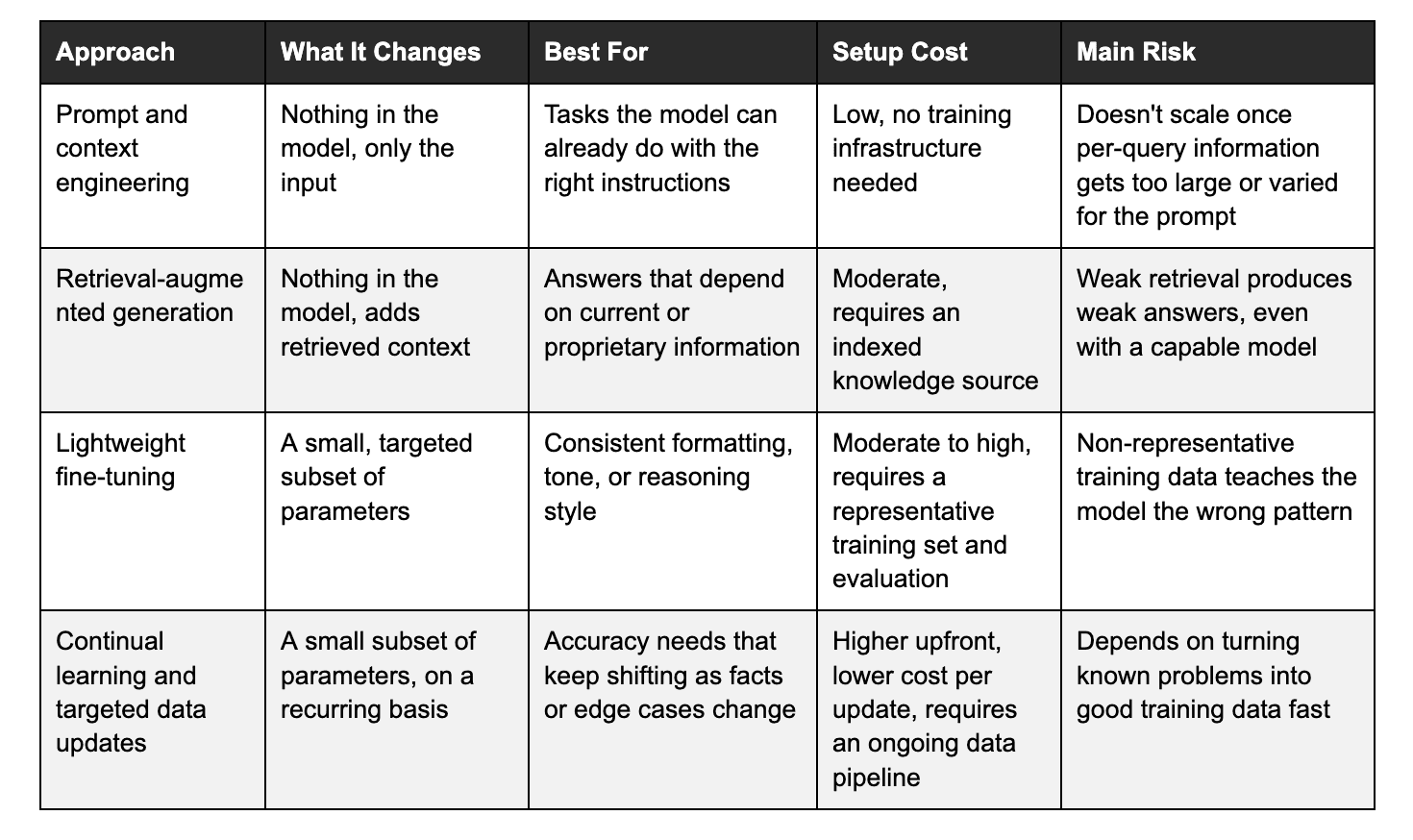
Improving LLM Accuracy Without a Full Retrain
If eval failures point to missing or outdated information, start with prompt engineering or retrieval, and choose retrieval once that information is too large or dynamic for a static prompt. If eval failures point to inconsistent behavior on a task the model already understands, lightweight fine-tuning is usually the more direct fix. If the issue you're fixing is a recurring one, continual learning is the best fit.
Still, these approaches aren't mutually exclusive, and most production systems combine them. RAG supplies current facts, prompt engineering handles formatting and instructions, and a lightweight fine-tune or continual data refresh addresses behavior that drifts as the underlying data changes. A team might start with prompt engineering to establish a baseline and a solid evaluation set, add retrieval once the required knowledge base outgrows the context window, and add a targeted fine-tune or continual learning loop once evaluations show a specific, recurring behavior problem that more context doesn't fix.
Author
Adaption TeamDate