
A team fine-tunes a model, evaluation scores go up, and the launch gets scheduled. But production tells a different story. The assistant refuses tasks the base model used to handle without complaint. It cites a pricing policy that changed months ago and answers the same question differently depending on how a customer phrases it. The team retrains and adjusts a hyperparameter or two. Sometimes there's improvement, but sometimes the regression just moves somewhere else.
The instinct is to blame the fine-tuning method: the wrong parameter-efficient technique, a learning rate set too high, or not enough training steps. Often the real problem is the dataset the fine-tune was built on. Fine-tuning is a training technique. It cannot fix a dataset that is stale, duplicated, inconsistently labeled, or missing important or niche cases. This article looks at the data quality problems that most often break fine-tuning runs, how to tell a data problem from a model problem, and what changes when a team treats its training data as an ongoing job rather than a one-time export.
What Is Fine-Tuning?
Fine-tuning takes a pre-trained model, one already trained on a large, general corpus, and continues training it on a smaller, task-specific dataset. It’s one of a few ways to adapt a pre-trained model to new data, alongside retrieval-augmented generation and continual learning.
The goal of fine-tuning is to keep what the base model already knows and adjust its weights just enough to specialize it: a particular tone, a specific domain's vocabulary, a narrower set of tasks. That is different from pre-training a model from scratch, which starts from randomly initialized weights and requires far more data and compute.
“Fine-tuning" covers a range of specific techniques. Full fine-tuning updates every weight in the model, which is thorough but expensive. Parameter-efficient fine-tuning (PEFT) methods, most commonly Low-Rank Adaptation (LoRA), update only a small subset of parameters and capture most of the benefit at a fraction of the cost. Instruction tuning trains a model on paired prompts and responses so it learns to follow directions rather than simply predict the next word. Reinforcement learning from human feedback (RLHF) layers on top of that, using human or model-generated preference signals to push outputs toward qualities that are hard to specify through labeled examples alone, like helpfulness or tone.
Whichever technique a team chooses, all of them depend entirely on the dataset behind them. That is where fine-tuning most often goes wrong.
Fine-Tuning Assumes the Data Feeding It Is Already Right
Most fine-tuning guidance treats the training dataset as a fixed input, something that already exists in good order by the time the tutorial begins. Production teams rarely get that starting point. Their dataset is usually assembled under deadline pressure from support tickets, sales call transcripts, internal documents, or synthetic generations, and it has typically never been audited for duplication, labeling consistency, or coverage. Fine-tuning then does exactly what it is built to do: it updates the model's weights to match the patterns in that dataset, flaws included. A model can only be as reliable as the examples it was shown, and a training run has no way to tell a real pattern from an artifact of how the dataset happened to get built.
Five Data Quality Problems That Break Fine-Tuning Runs
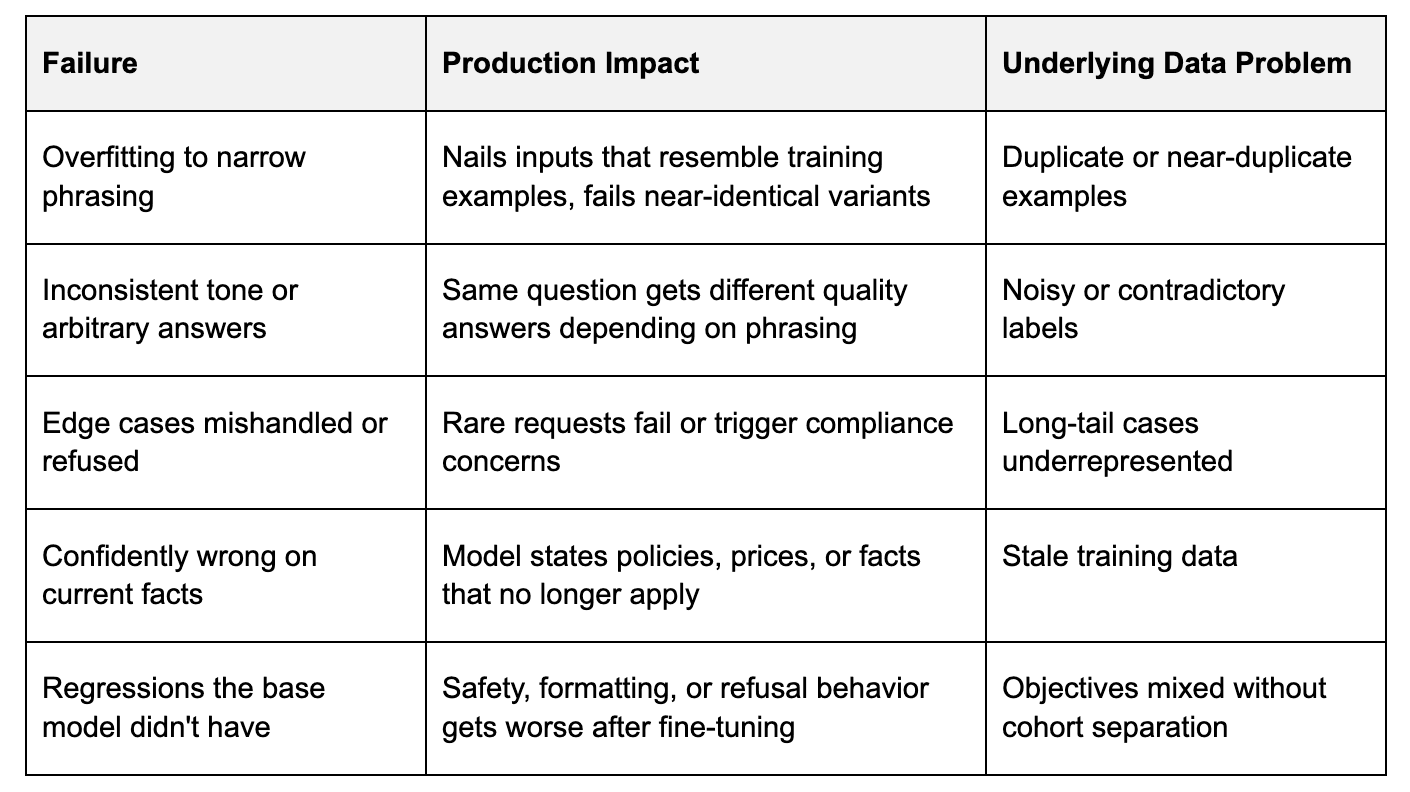
These are five common problems, and most real-world datasets have more than one at a time.
Duplicate and Near-Duplicate Examples
Datasets built from scraped tickets, chat logs, or generated synthetic data commonly contain the same example, or a near-identical rephrasing of it, dozens of times over. Fine-tuning on a heavily duplicated dataset pushes the model to overfit those specific phrasings: it performs well on inputs that resemble the duplicates and degrades on the adjacent cases a person would expect it to handle the same way. Overfitting is a well-documented risk of fine-tuning generally, and unnoticed duplication is one of the most common ways a team walks into it without realizing the dataset was ever imbalanced.
Inconsistent or Noisy Labels
When labeling happens across multiple annotators, contractors, or generation passes without a shared standard, the same type of input ends up with contradictory "correct" answers scattered through the dataset. The model cannot tell that these are errors rather than legitimate variation, so training averages across the contradiction. That average is exactly the inconsistent tone or arbitrary answer quality that shows up later as unpredictable production behavior.
Duplication and label noise are both quality problems, and neither shows up in an aggregate eval score. Adaptive Data takes a raw dataset and optimizes it for training, improving its quality on an ongoing basis. That ongoing improvement is what catches contradictory or low-quality labels, instead of leaving a team to audit label consistency by hand before every fine-tune.
Long-Tail Cases Left Out
A dataset tends to reflect whatever was easiest to collect, so common cases are well represented while rare but important ones, an uncommon product configuration, a regulatory exception, a request in an underrepresented language, are thin or missing entirely. A fine-tune trained on that distribution learns the common cases well and has nothing to generalize from for the rest, which is precisely where enterprise deployments run into legal, safety, or brand risk.
Adaptive Data's approach to quality explicitly includes surfacing long-tail examples, and for cases where no example exists at all, such as a new product line or an underrepresented language, Invent a Dataset can build a training set directly from a description of the task instead of waiting for real examples to accumulate.
Stale Data That No Longer Matches Production
A dataset assembled six months before a fine-tuning run reflects the product, pricing, and policies of six months ago. Nothing in the fine-tuning process itself catches this. The model confidently reproduces outdated information because outdated information is what the training data said was correct.
AutoScientist automates the research loop behind training, so teams can retrain before the gap between the data and reality grows six months wide again.
Mixed Objectives Without Cohort Labels
Teams often combine style, task, and policy examples into a single training set without labeling which cohort an example belongs to. The model gets no signal for when to prioritize tone against task completion against a safety constraint, so those objectives pull against each other during training.
In more aggressive alignment pipelines, repeated rounds of preference optimization on an unlabeled mix like this can prune away the model's useful diversity of response, leaving a model that looks fine on a narrow evaluation set and turns brittle against the variation real users produce. Blueprint, a specification layer of Adaptive Data, lets a team define the goals, tone, and policy for each cohort, so style, task, and safety examples do not have to share the same undifferentiated training signal.
How Data Quality Affects Production
How to Tell a Data Problem From a Model Problem
Before reaching for a different fine-tuning technique, it is worth ruling data out first, since most of the checks are cheap relative to another training run.
- Check for duplication first. Run a similarity check across the training set. A dataset where a meaningful share of examples cluster tightly together is telling you what the model overfit to before you ever look at outputs.
- Segment evaluation by cohort. An overall score that looks fine can hide a subset, a rare intent, a specific language, an edge case, that is failing badly. Aggregate metrics average that failure away.
- Compare specific pre- and post-fine-tune behavior. If the base model handled a case correctly and the fine-tuned model no longer does, that strongly signals the fine-tuning data taught the model something wrong, rather than simply failing to teach it something new.
- Check the training data's timestamp against what is true today. If the two have drifted, no adjustment to the training method will fix the gap.
The Cost Enterprises Pay for a Failed Fine-Tune
For a director or VP weighing a fine-tuning investment, these failure modes are not just an engineering nuisance. Each failed run means GPU spend that has to be paid for again, a launch date that slips while the team investigates, and, if the model shipped before the problem was caught, a live regression in front of customers or regulators. Because the underlying cause is usually invisible without a deliberate audit, teams often repeat the cycle two or three times, changing training parameters each round, before anyone checks whether the dataset itself was ever sound. That repeated cycle is frequently the more expensive part of the project, not the original training run.
Treat the Data Layer as Infrastructure
Most things that break a fine-tuning run are fixable before training starts, and most are data problems rather than modeling ones. None of it replaces the training decisions that are the fine-tuning method's job: choosing PEFT versus full fine-tuning, the learning rate, the number of steps. But those decisions only matter if the dataset feeding them wasn't duplicated, stale, or missing the edge cases a team never got around to collecting. Fix that, and the next fine-tune stands a real chance of working.
Author
Adaption TeamDate