Home
BlogCareers

Featured Story

Product

AutoScientist: Automating the Science of Model Training

Adaption Research Staff

·

May 13, 2026

·

3min read

Less than a thousand people in the world know how to shape a frontier model. They sit inside a handful of labs, working on proprietary systems. Everyone else has been relegated to prompt engineering, contorting requests to fit models built for the average use case.

At Adaption, we believe that should change. Intelligence should not arrive preconfigured, and building AI shouldn’t require a PhD.

Model training and reinforcement learning are among the most powerful ways to shape a model, and among the hardest to get right outside a frontier lab. Most attempts fail for the same reasons: catastrophic forgetting that erodes general knowledge, overfitting on small or low-quality datasets, and conflicting training signals that fail to teach new behaviors. The techniques that work are passed researcher-to-researcher, rarely written down. The result is a world where a small group of experts defines what AI can and cannot do, while everyone else is left on the sidelines.

Today we’re introducing AutoScientist, a system that self-improves and automates the full research loop behind model training and alignment.
AutoScientist: An Important Cornerstone of Automating AI R&D

AutoScientist co-optimizes your data and model training recipes automatically, self-improving across both until quality converges on your objective.

Where Adaptive Data shaped the inputs, AutoScientist shapes the model, running the full research loop end-to-end so you walk away with models adapted to your goal. The loop runs itself: data and recipes are co-optimized in lockstep, iterating until the model converges on the behavior you described.

For developers, that means going from idea to an owned, adapted model in an afternoon, not weeks. For non-technical builders, it opens a door that has historically been closed: the ability to shape and train a model, not just prompt one. An ML engineer who knows they need fine-tuning (domain language, structured output formats, latency/cost from a smaller model), but doesn't have time to babysit sweeps. Enterprises that want to offset inference bills depending on proprietary models. It unlocks proprietary data and makes it visible to AI. AutoScientist unlocks AI systems that are easier to develop, easier to evaluate, and easier to evolve as goals change and new inputs emerge.

AutoScientist: An Important Cornerstone of Automating AI R&D

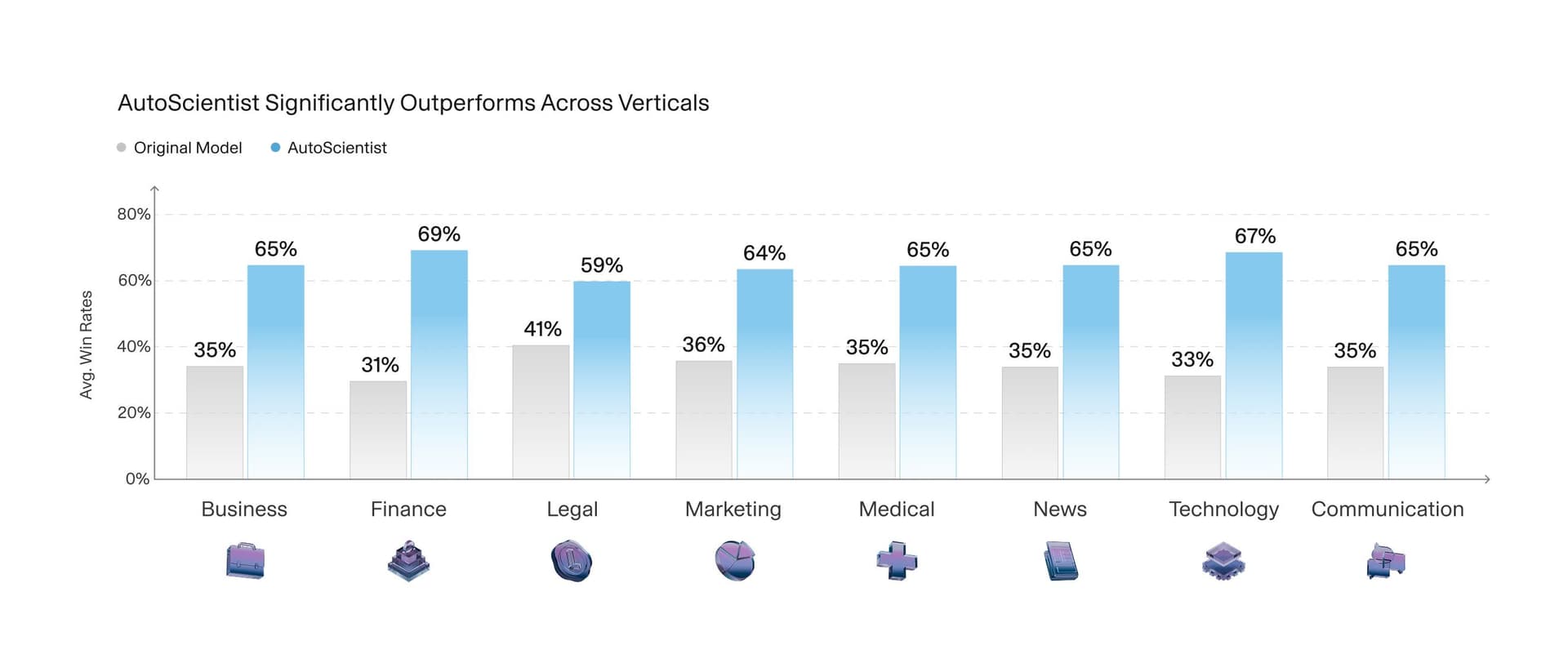
Figure 1. AutoScientist outperforms the original model performance, with sizable gains across different dataset sizes (ranging from 5k-100k), model architectures offered by Together AI for fine-tuning and verticals. The average performance across all runs is notable for showing consistent gains against the base model irrespective of domain. Win rates are computed on in-house domain-specialized evaluations for each vertical.

From Adaptive Data to Adaptive Systems

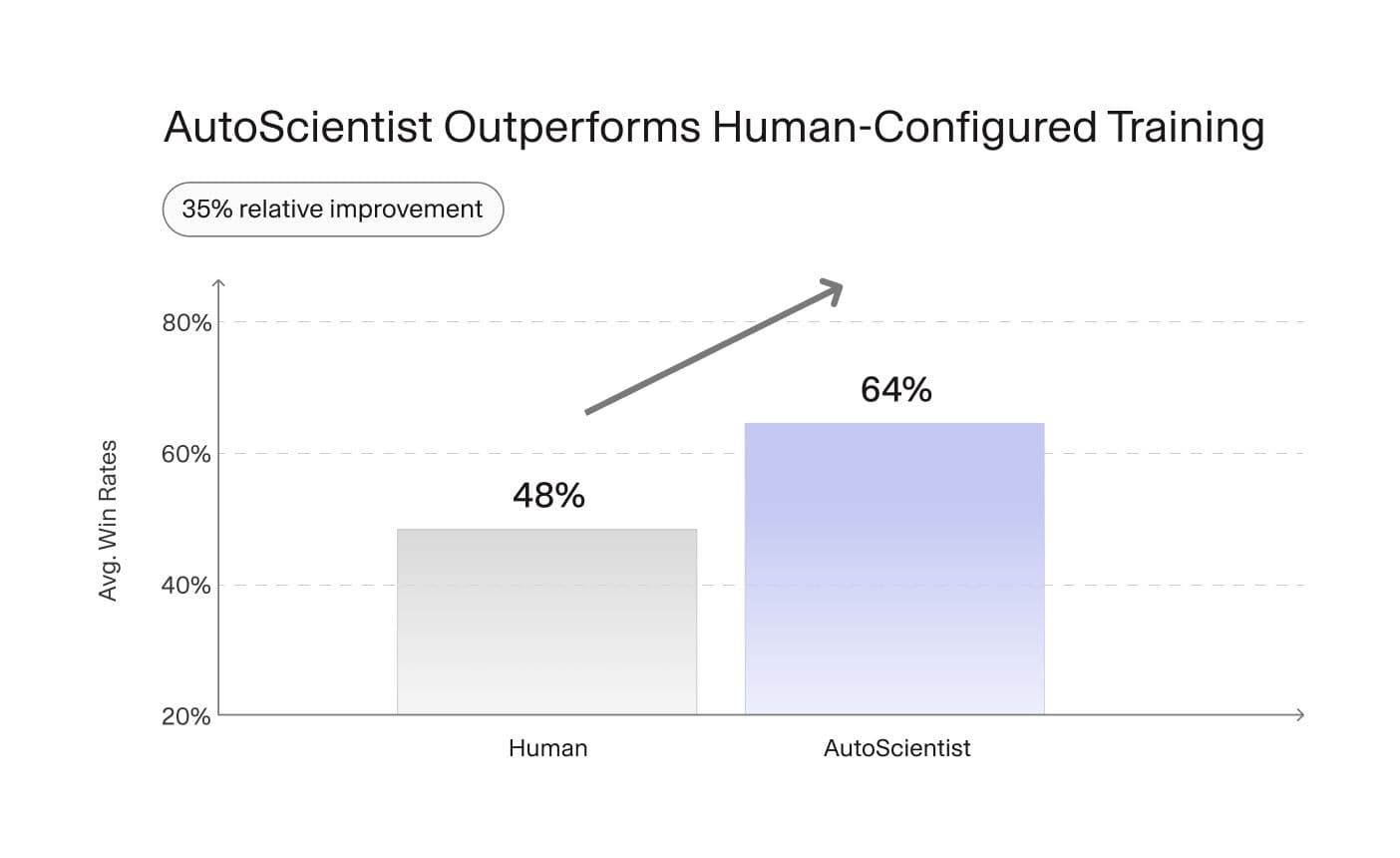
As shown in figure 1, AutoScientist outperforms human-configured training by our in house AI research staff by an average of 35% across all runs. Research staff were allowed to set configurations based upon knowledge of model type, domain and dataset size. AutoScientist was given access to the same information and also allowed to self-improve based upon a limited number of historical runs. In aggregate, win rates improved from 48% to 64% when AutoScientist was used instead of the AI researcher recommendation.

We also find in figure 2 that AutoScientist is not sensitive or overfit to vertical. Most fine tuning runs fail in the real world, but AutoScientist produces predictable gains against the original model across all 8 verticals (we benchmark the average of runs across models hosted for fine-tuning by Together AI). This is exciting because it unlocks robust and reliable gains across many different types of tasks.

From Adaptive Data to Adaptive Systems

Figure 2. AutoScientist outperforms human-configured training, even when set by an AI researcher. We report average measure performance across verticals, dataset sizes (5k-100k) and model architectures offered by Together AI for fine-tuning.

The Way Forward

AutoScientist is one of our first releases that aims to learn how to shape model behavior automatically. Long horizon reasoning is one of the hardest unsolved problems in AI, and it’s what holds models back from reliability on a lot of tasks they appear capable of. AutoScientist is the first step in automating research and development, starting with model training.

In the near future, we are working on learning techniques that enable real-time adaptation without requiring training at all.

Model Ownership for Everyone

AutoScientist makes it possible for anyone, not just AI researchers, to shape and refine the AI they depend on. For the next 30 days, AutoScientist is free to use.

Intelligence should not be limited to those who already know how to build it.

Author

Adaption Research Staff

Date

May 13, 2026